Species and model
Mouse model of androgenetic alopecia. Secondary reporting adds: experimentally induced pattern hair loss, treated on shaved backs.
The comb
ElectroComb
Turn the comb. Follow the field, the payload, and the follicle.
Teaching model · not an engineering drawing
Arrow keys tilt the model when the frame is focused. Pointer movement adds a small parallax. Hover is not required.
Teeth, a clear housing, and a board in the handle. The next chapter opens each region.
Whole device
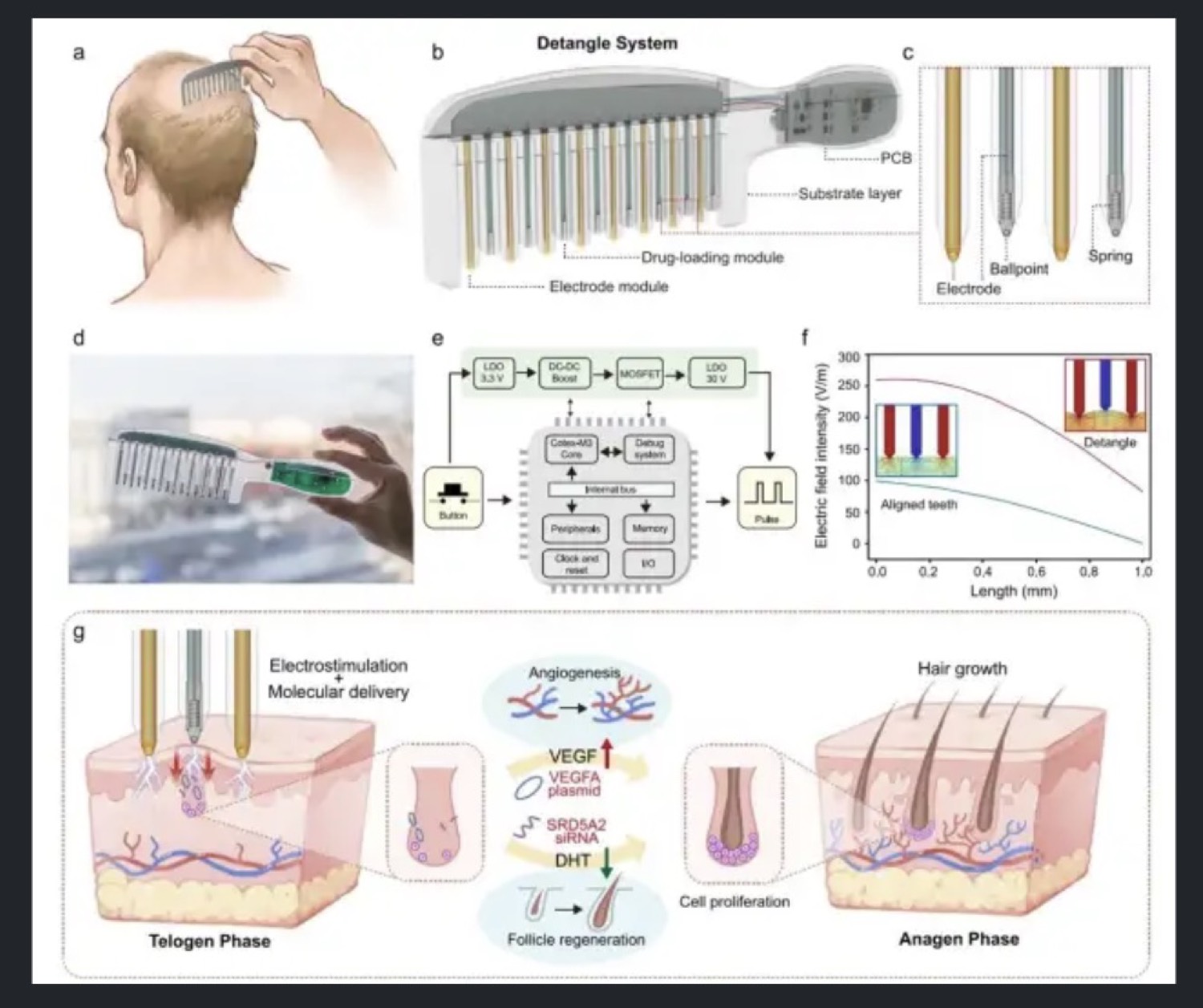
A transparent comb-shaped instrument: teeth to meet the skin, a payload associated with some teeth, and electronics in the handle.
Illustrative assembly
Height-differentiated electrodes and drug-loading modules are what the abstract describes.
02 — Device
Five regions you can select, from housing to the point of contact.
Teaching model · not an engineering drawing
Arrow keys tilt the model when the frame is focused. Pointer movement adds a small parallax. Hover is not required.
Whole device
A transparent comb-shaped instrument: teeth to meet the skin, a payload associated with some teeth, and electronics in the handle.
Illustrative assembly
Height-differentiated electrodes and drug-loading modules are what the abstract describes.

03 — Field
A pulse drawn from the comb into a cross-section of skin.
A field, drawn through the skin.
The authors describe a deeper local field together with molecular delivery.
04 — Pathways
A VEGFA plasmid for vessel signals. An SRD5A2 siRNA on the path toward DHT. Then both.
A DNA circle encoding VEGFA is meant to be taken up so follicle-region cells make more of a vessel-growth signal. The hope is better local blood supply.
VEGFA is the gene for vascular endothelial growth factor A. A plasmid is a circular DNA used as a temporary instruction. Cells that read it can secrete VEGF protein, which can invite microvessel growth.
Both molecules are named in the abstract. The plasmid and the siRNA stay visually distinct, and neither is drawn as a permanent edit.
05 — Cycle
A resting follicle and a growing one, as a diagram of the cycle.
From rest toward growth.
Resting phase. The follicle is drawn short, with little shaft above the skin.
06 — Study
The mouse study behind the comb, in the wording of the abstract.
Mouse model of androgenetic alopecia. Secondary reporting adds: experimentally induced pattern hair loss, treated on shaved backs.
Abstract: within one month. News report: once every three days for 28 days. The schedule was not re-read in the full methods.
The comb-shaped device, local electrical stimulation, a VEGFA plasmid, and an SRD5A2 siRNA — used together in the reported experiment.
Conventional topical minoxidil, described in the abstract as about 70% on the same kind of endpoint. A news report also says finasteride was outperformed, without a verified percentage.
Treated-area coverage in the mouse study. Abstract wording: from about 70% with minoxidil to nearly 100% with the combined approach.
The abstract’s comparison, drawn as a sketch of the mouse study.
Nearly complete
Combined approach in the mouse study. Abstract: nearly complete coverage.
About 70%
Topical minoxidil comparator in the same kind of mouse experiment. Abstract: ~70%. Approximate.
Every substantive statement used above lives in this list, with its category and source marker.
07 — Release
What the program measures next.
01
Mouse study
02
Phase 1
03
Phase 2
04
Phase 3
05
Release
Releasing only after passing Human Trials Phase 1, 2 & 3